Roof leak detection and risk management: measuring humidity and temperature is not enough
At Inscio Roofs, we measure moisture (conductivity), humidity, and temperature in roofs. And we do so for a very good reason. Only by monitoring these three parameters together can we obtain a complete picture of what is happening in a roof. While humidity and temperature mainly help to identify trends and deviations, only the measurement of free moisture (higher conductivity) can provide certainty as to whether there is a real risk. We know this not from theory, but from experience—based on millions of measurements in roofs.
Humidity is not a reliable indicator
What we see in practice: humidity in a roof is largely determined by conditions on the day of installation. Is it wet during construction? Then the roof starts with high humidity. Is it dry? Then low.
In other words: humidity is anything but constant. A value of 95% or even 99% humidity can be quite normal. We even regularly see roofs with 99% humidity, without measuring any free moisture. In addition, humidity can increase significantly when the temperature drops, even though no moisture is entering the roof through a leak.
Controlling only humidity and temperature in a roof is pointless: the difference between a tablespoon, 10 liters, or even 50 liters of water cannot be determined. That is simple physics.
Explained: simple physics
Air can only absorb a very limited amount of water. Once that limit is reached, 100% humidity is measured. At 20 degrees, air can hold a maximum of 17.3 grams of moisture per cubic meter. To give you an idea, that is one tablespoon of water.
This makes controlling humidity and temperature in a roof pointless: the difference between a tablespoon, 10 liters, or even 50 liters of water entering the roof cannot be determined. In all cases, the measurement shows 100% humidity. Simple physics.
The risk? Roofs are opened up unnecessarily, resulting in high costs and disruption, while no moisture is entering the roof and therefore there is actually no problem.
Monitoring with sensors and data
And ultimately only one thing counts: is there actually moisture present in the roof?
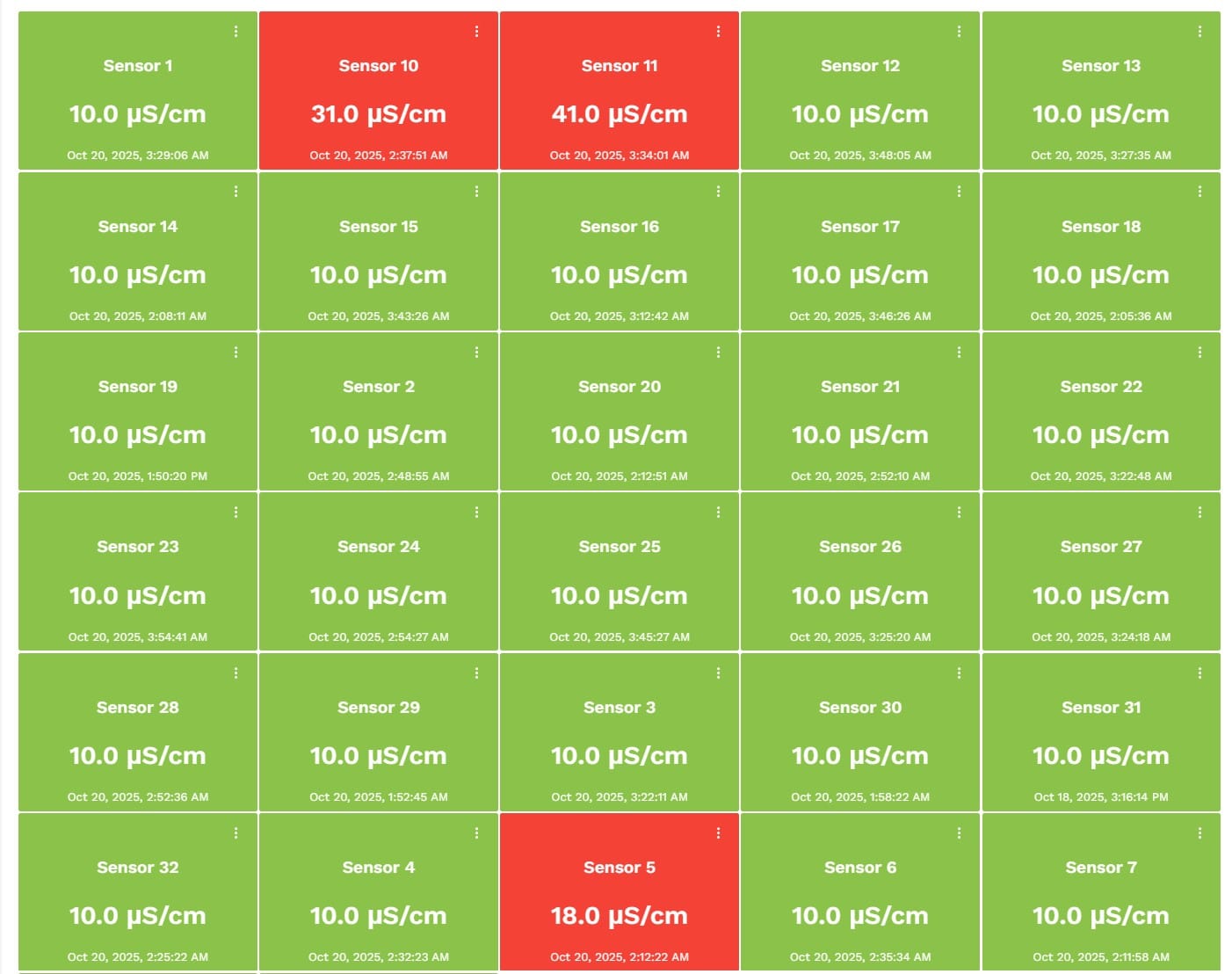
We determine that via conductivity. Water conducts, dry material does not.
Higher conductivity = more moisture.
No conductivity = no moisture.
And it's that simple. By measuring free moisture, you have certainty whether there is a problem in the roof. And we know this not only because it sounds logical, but because we see it time and again in our practical measurements. Millions of data points confirm it: humidity alone is not enough.
For the property owner and roofer, this means: no unnecessary interventions, better risk management and longer roof life.
“If you only measure humidity and temperature, you won't get certainty, just a guess. Measuring moisture (conductivity) is the only hard truth.”